The Honest Comparison
PDR vs Body Shop: When to Choose Each
A plain-language comparison of paintless dent repair and traditional body shop dent repair. Joe Garcia has been reading panels in the Inland Empire since 1997. Here is how he tells clients to think about the choice.
Two repair paths, two different outcomes
When a vehicle gets damaged, the owner usually has two real options for fixing it: paintless dent repair (PDR) or conventional body shop work. The two methods are not interchangeable. They use different tools, take different amounts of time, and leave the vehicle in a different state when they are done.
This guide is not about which is “better” in the abstract. The right answer depends on the damage in front of you. Some dents are textbook PDR. Some genuinely need paint and filler. Some live in between, and the call has to be made by a technician with the panel under proper light.
Joe runs Dent Evo out of a shop on Dewey Way in Upland. He has worked panels for clients across Upland, Claremont, La Verne, Glendora, Pomona, Rancho Cucamonga, Ontario, Chino, and Chino Hills since 1997. The framework below is the same one he uses when a customer pulls into the bay and asks, “Should this go to a body shop?”
What PDR actually does
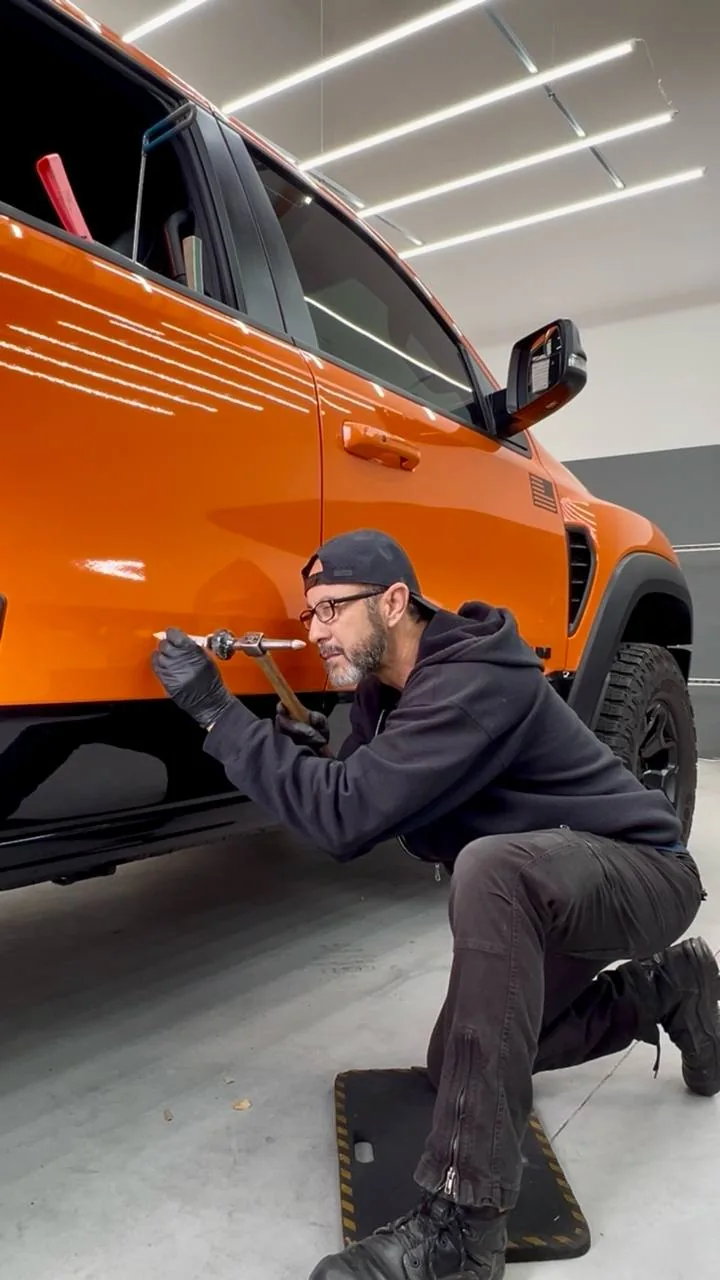
Paintless dent repair works the metal back to its original shape from behind. The technician uses long, contoured rods and tipped tools, inserted through factory access points like window slots, tail-lamp pockets, or interior trim openings. With the panel lit at a controlled angle so every high and low spot reads on the surface, the technician applies precise, repeated pressure to the back of the dent.
The metal moves in small increments. Steel and aluminum both have memory — they want to return to their factory shape if you read them correctly and walk them back. Done well, the dent disappears. The factory paint and clear coat are not sanded, primed, or repainted. The panel comes out with the same paint it left the factory with.
That last point is what makes PDR distinct. It is not a “quicker” version of body shop work. It is a different category of repair entirely — a metal-finishing technique that leaves the original surface intact.
What PDR cannot do
PDR cannot put paint back. If the paint is cracked, chipped, broken, or missing, no amount of metal work behind the panel will replace it. PDR also cannot repair sharp tears in the metal, deep gouges, or sections where the panel has been cut. There are real limits, and a credible PDR technician calls them out before quoting.
What body shop dent repair does
Conventional body shop dent repair takes a different approach. The damaged area is sanded down to bare metal. Body filler is applied to bring the surface back to the original contour. The filler is sanded smooth. Primer is sprayed. Color base coat is matched, blended into adjacent panels, and applied. Clear coat goes on top. The panel is baked or air-cured.
If the damage is severe, the panel might be replaced entirely. A new panel is welded or bolted in, then primed and painted to match the rest of the vehicle.
Body shop work is the right answer when the metal has been deformed past its memory point, when paint is missing or cracked, when there are sharp creases that PDR cannot move, or when a panel needs to be replaced. It is real, skilled work. It is also a different repair than PDR. The original factory paint is no longer there. The panel has been refinished. That distinction matters when the vehicle is later inspected, appraised, or sold.
PDR vs body shop — the comparison that matters
Here is the head-to-head on the dimensions that actually affect the vehicle and the owner. Cost is intentionally not in this table. The right way to choose between PDR and body shop is by outcome, not by the invoice.
| Dimension | Paintless Dent Repair | Body Shop Repair |
|---|---|---|
| Original paint preservation | Factory paint preserved, no refinishing | Original paint sanded, refinished, and reapplied |
| Carfax repair record | No Carfax record when paid out of pocket | Repair history typically reported and visible at resale |
| Time to complete | Most repairs same day; complex jobs 1–2 days | Multiple days for paint and cure; longer for panel replacement |
| Panel structure | Original factory metal, unaltered | Filler applied, sanded, refinished — or panel replaced |
| Resale and appraisal impact | No impact — panel reads as factory | Refinished panel often visible to inspectors and dealers |
| Suitability by damage type | Dents and dings with intact paint, accessible from behind | Cracked paint, sharp tears, missing metal, panel replacement |
| Long-term durability | Repair is permanent — the metal is back where it started | Quality depends on prep, paint match, and shop standards |
| Color match | Not applicable — no paint touched | Match quality varies; metallics and pearls are hardest |
Outcome-based comparison. The right path depends on the damage, not the line item.
Not sure which path is right for your dent? Send a photo — Joe will tell you straight.
When paintless dent repair is the right call
PDR is the right answer when the damage profile lines up with what the technique can do. The classic PDR-friendly dents are:
- Door dings from parking lots. Round, shallow depressions where another car door, a shopping cart, or a bicycle made contact. Paint almost always intact.
- Hail damage. Multiple small, rounded dents across hoods, roofs, and trunk lids. Paint usually unharmed. PDR is the standard repair path for hail.
- Quarter panel dents from a stray ball, swung door, or cart. Soft impacts that push the metal in without breaking finish.
- Hood dents from windborne debris. Branches, tree fruit, or trash that hit the hood without sharp force.
- Tailgate or trunk lid creases that haven’t broken paint. If the metal moved but the clear coat held, PDR has a working window.
- Aluminum panel dents on EVs and modern trucks. When approached carefully and read first, most aluminum dents with intact paint are PDR candidates — if the technician has the right tools and the experience to work aluminum without overdriving it.
The shorthand: smooth deformation, paint intact, panel accessible from behind. If those three conditions are present, PDR almost always produces the cleaner outcome.
When a body shop is the right call
Joe tells clients straight when their damage is past PDR. Trying to force PDR onto a panel that needs paint wastes the customer’s time and risks a worse-looking result. The honest list of body-shop cases:
- Cracked or missing paint. If the clear coat has split, fractured, or chipped off, the panel needs refinishing. PDR alone cannot put paint back.
- Sharp creases with stretched or torn metal. When the metal has gone past its memory point and there is visible tearing or thinning, body work is required.
- Edge damage. Dents that fold over body lines or wrap around the very edge of a panel often cannot be reached or worked back cleanly.
- Damage with rust starting. If oxidation has begun where paint broke, the panel needs to be properly refinished and sealed.
- Severe collision damage. Anything involving structural crumple, bent reinforcements, or pushed frame work goes to a collision shop.
- Panels that need replacement. Punctures, deep gouges, large sections of missing metal — replacement, not repair.
If the damage falls into any of those categories, PDR is not the path. A good PDR technician will tell you that on the spot.
The cases where evaluation actually matters
Most damage is not at the easy ends of the spectrum. Most damage lives in the middle — where the call is judgment, not formula. Some examples Joe sees often:
- A larger door dent where the paint is mostly intact but there is a small hairline at the lowest point. PDR may bring the metal back, but the hairline may need a cosmetic touch-up.
- A crease that runs near a body line. If the line itself is preserved and the crease is shallow, PDR has a chance. If the line is bent, refinishing is more likely.
- Hail damage on an aluminum hood where most of the dents are workable but two or three have deeper folds. The repair may be 90% PDR with a small refinishing area.
- A quarter panel dent where the body shop access is partially blocked by interior bracing. PDR is possible, but takes more time, and the technician needs to confirm reach before quoting.
These borderline cases are where the value of an experienced evaluation shows up. The wrong call goes one of two ways: a body shop sells refinishing on a panel that did not need it, or a PDR technician overpromises a repair that should have gone to paint.
Joe’s rule: If a technician quotes a borderline panel without picking it up under proper light and reading the surface from multiple angles, the quote is a guess. Get the panel evaluated, not just photographed.
Behind the Panel
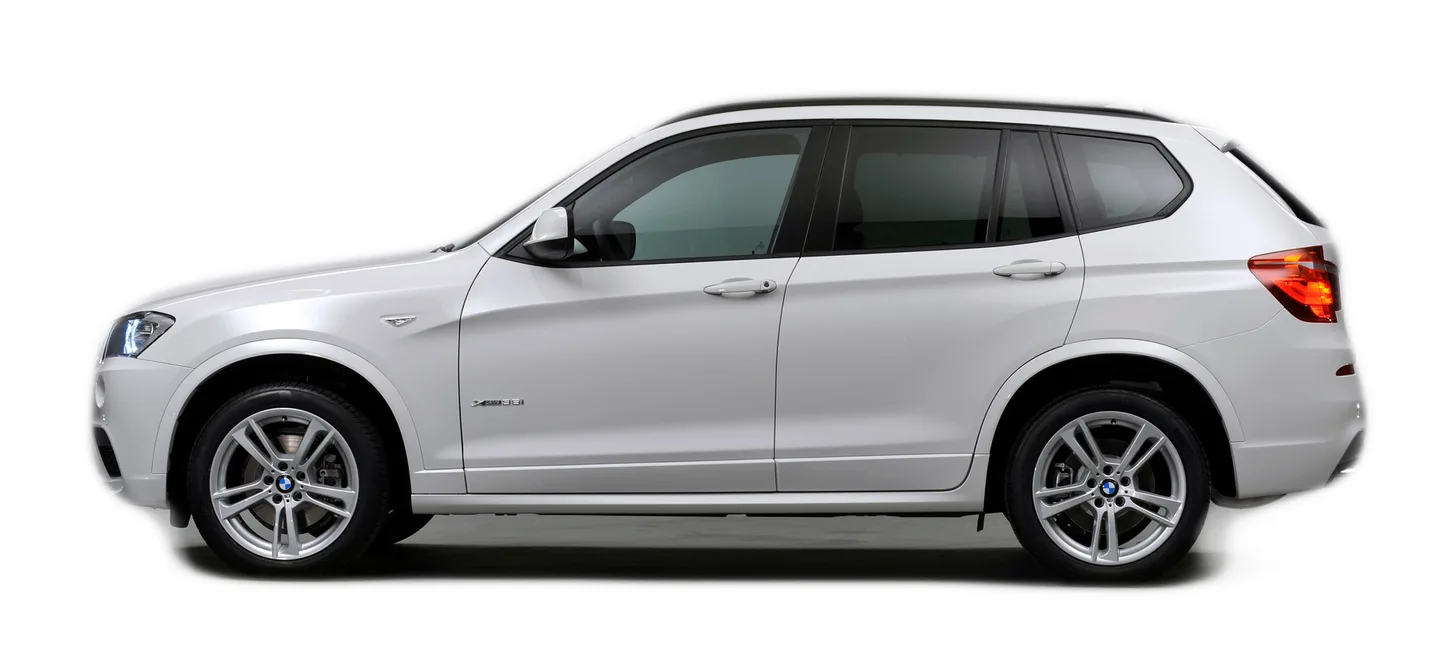
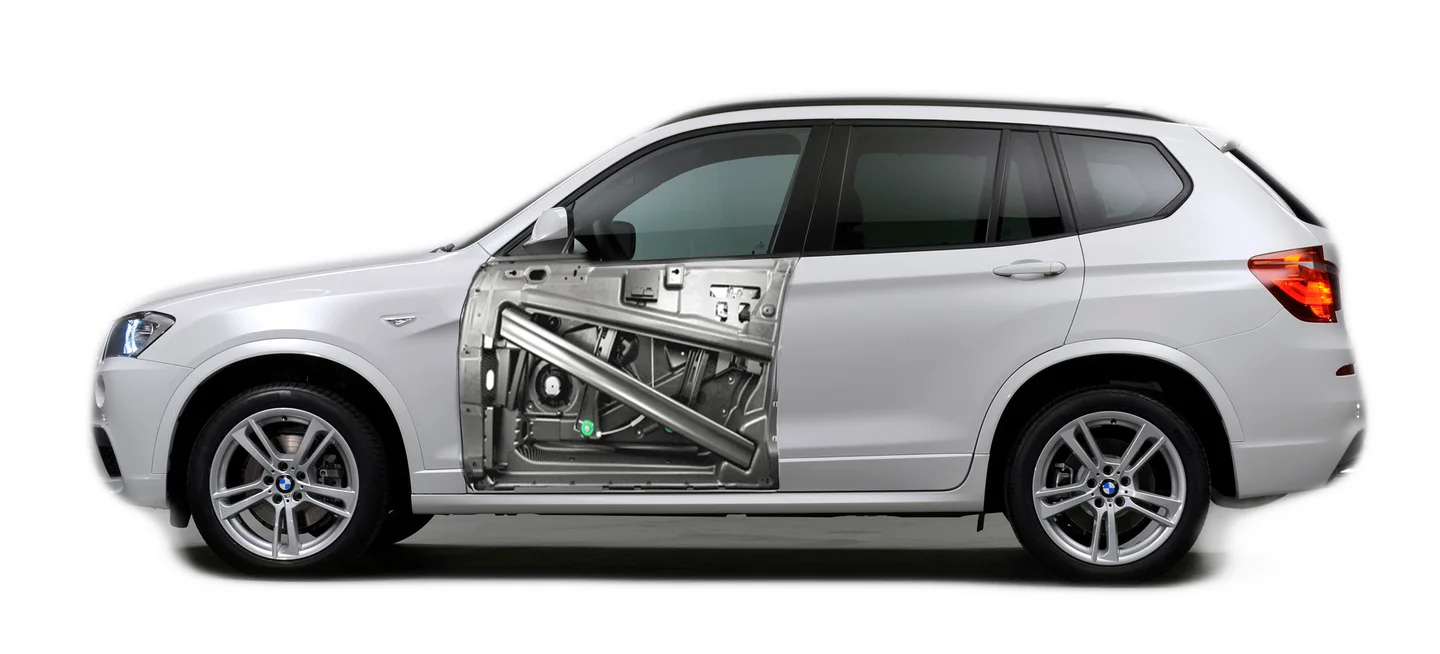
That dent looks simple. Until you see what’s behind the panel.
What looks like a small surface ding sits in front of a precisely engineered structure. PDR technicians work blind — navigating every brace, bracket, and reinforcement to restore the panel without a trace.
← drag to reveal →
Why the evaluation Joe does is different
An evaluation at Dent Evo is not a price first. It is a read of the panel first — with proper lighting, hands on the metal, and a check of the paint condition under angle. Only after the panel has been read does a quote come.
Joe’s standard practice is to call out limits up front. If a section of the dent is going to need cosmetic touch-up after PDR, he tells the client before any work starts. If the damage is past PDR entirely, he says so — and points the client toward a competent body shop in the area instead of taking a job he cannot finish well.
This is the part that separates evaluation-driven PDR from quote-first PDR. The right path for a given panel is not always the path that lands more revenue at Dent Evo. It is the path that produces the cleanest outcome for the vehicle.
Every Dent Evo repair carries our complete satisfaction guarantee or no charge applied. Dents done right do not come back — so the panel either reads correctly when you walk out, or there is no charge.
Frequently asked questions
How do I know if my dent is a PDR candidate or a body shop case?
The fastest way is a free photo evaluation. Take three photos — one straight on, one at a 45-degree angle, and one close-up of the deepest point — and send them to Joe. Most damage can be classified from photos. Borderline cases get an in-person look. The evaluation is free either way.
Will my insurance cover PDR?
For comprehensive claims like hail damage, yes — PDR is the standard. For collision claims involving cracked paint or panel replacement, body shop work may be required. The PDR evaluation will confirm what the actual damage profile calls for, and the insurance question follows from that.
Does PDR last as long as a body shop repair?
PDR is permanent. The metal has been moved back to its factory position. There is nothing to crack, peel, or fade because no paint or filler was added. Body shop repairs depend on the quality of the prep and paint — a clean refinish lasts a long time, but it is a different kind of repair.
What if the dent shows up later as a Carfax record?
PDR paid out of pocket, outside of an insurance claim, does not generate a Carfax entry. The repair touches metal only — it does not pass through a body shop’s reporting workflow. This is one of the reasons clients with newer vehicles, leases, and high-resale models prefer PDR when the damage qualifies.
Does Dent Evo do body shop work too?
Dent Evo is a paintless dent repair specialist. We do not paint, fill, or replace panels. When a panel needs body shop work, we say so and refer to local shops we trust in the Inland Empire. We focus on PDR because that is the work we do at the highest level.
Where is Dent Evo located?
1220 Dewey Way Suite A, Upland, CA 91786. We serve clients across the Inland Empire and the foothill communities — Upland, Claremont, La Verne, Glendora, Pomona, Rancho Cucamonga, Ontario, Chino, and Chino Hills. Call (909) 340-3440 to talk through a damage scenario before you bring the car in.
Get a straight read on your panel
Send Joe a few photos of the damage. He will tell you whether it is PDR or body shop, what the path looks like, and what the repair involves — before any commitment.