Hail Damage Repair.
No Repaint. No Filler. No Record.
One storm leaves hundreds of dents across every panel. Joe Garcia has been mapping and removing hail damage since 1997 — restoring vehicles to pre-storm condition without a single drop of paint.
Every Storm Is Different. Every Dent Needs a Plan.
Hail damage isn’t one type of problem — it’s a pattern of problems across multiple panels, each with different depth, size, and paint stress. Understanding the damage type is the first step to a proper repair.
Small & Marble-Size Hail
Dozens to hundreds of shallow, round dimples across hood, roof, and trunk. Paint is typically intact. Best PDR candidate — complete restoration is almost always possible.
Golf Ball & Larger Hail
Deeper impacts, wider diameter. May stress or spider-web paint around the impact edge. Still commonly PDR-repairable — paint integrity determines the outcome.
Paint-Cracking Impacts
Where hail cracks the clear coat or base coat, PDR addresses the metal contour. Paint chips are handled separately with touch-up — Joe identifies these during mapping.
Why PDR Is the Right Answer for Hail.
A body shop’s approach to hail means sanding, primer, and fresh paint on every panel. You lose your factory finish — and with it, your resale value.
Storm hit your car? Send photos — Joe will tell you straight what PDR can do.
How Joe Works a Hail Job.
A systematic approach is what separates a clean result from one that looks rushed. Joe follows a deliberate process on every hail job — no shortcuts.
Full-Vehicle Dent Mapping
Before any repair begins, Joe maps every impact on every panel using specialized LED lighting and PDR reflector boards. Size, depth, location, and paint stress are documented. This mapping session drives the estimate and sets realistic expectations before work starts.
Panel-by-Panel Systematic Repair
Joe works methodically, panel by panel. Each dent is addressed with precision rods and picks from behind the metal — gradually restoring factory contour without filler, primer, or paint. Dense hail patterns require care to avoid creating new high spots while correcting adjacent dents.
Final Inspection Under Raking Light
Every repaired panel is re-examined under specialized lighting. Any remaining low or high spots are corrected before the vehicle is released. If it isn’t right under hard light, it isn’t done — period.
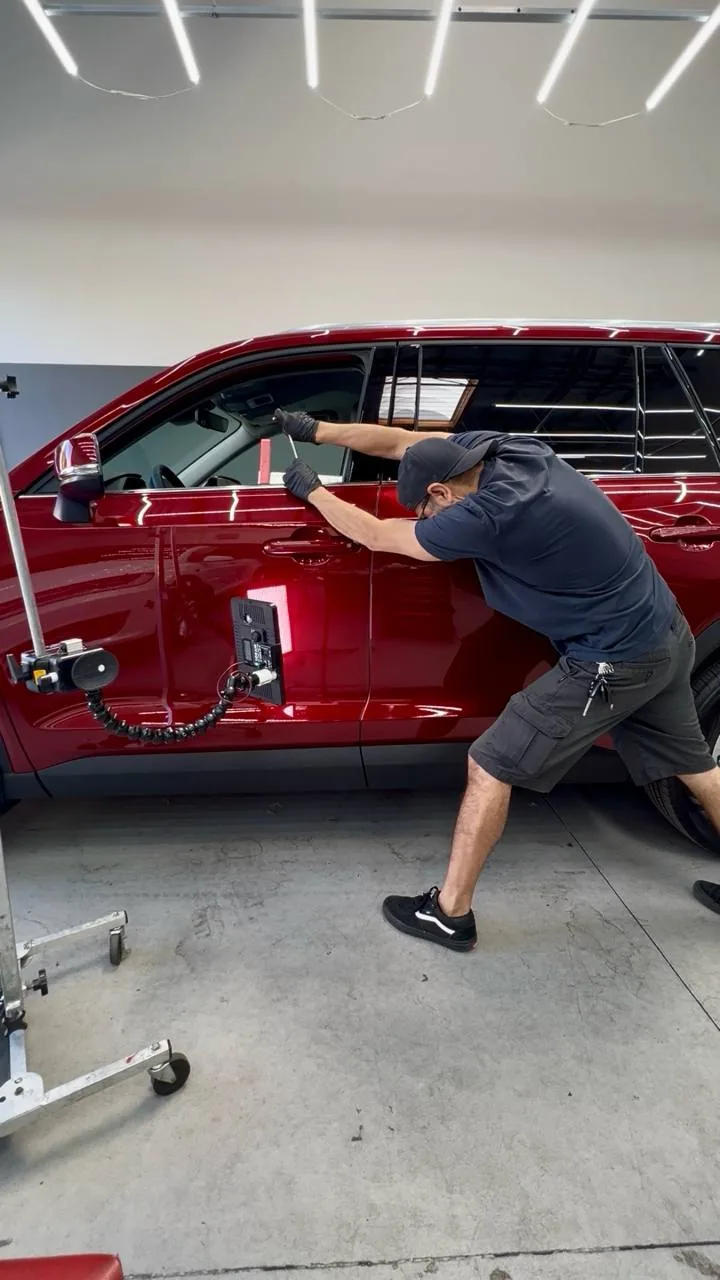
Every Make. Every Model. Steel and Aluminum.
Hail damage hits any vehicle caught in the storm. Joe works on all domestic and import makes — including EVs, trucks, SUVs, and daily drivers.
Hail Damage Repair Across the Inland Empire.
Based in Upland, CA — Joe serves the entire Inland Empire and San Gabriel Valley. When a storm rolls through San Bernardino or Riverside County, body shops fill up fast. PDR is the faster path back to a normal-looking car.
Hail in the Inland Empire — What We Actually See.
Hail in Southern California isn’t an annual ritual the way it is in Texas or Colorado, but the Inland Empire and San Gabriel Valley do get hit — often hard, and usually with little warning.
Where it concentrates
The foothill belt from La Verne and Claremont through Upland, Rancho Cucamonga, and into Fontana sits at higher elevation than the valley floor — a few hundred extra feet of altitude is enough to drop hail rather than rain when a cold storm cell rolls in off the San Gabriel and San Bernardino Mountains. Mountain communities like Big Bear and Wrightwood see frozen precipitation regularly. The lower elevation cities — Riverside, Corona, Ontario, Pomona — get hit less often, but when a fast-moving spring cell tracks through, the damage is still real.
Panels most affected
Hail falls vertically, so the horizontal panels take the worst of it: the roof first, then the hood, then the trunk lid. Vertical panels — doors, fenders, quarter panels — are hit only when wind drives the hail at an angle. On most vehicles we map, 70-80% of the impacts cluster on roof and hood, the rest spread thin across upper door tops, fender tops, and trunk lid. Mirror caps and pillar trim also pick up hits. Sail panels and the area above the rocker rarely show damage at all.
When it happens here
Late winter through spring is the window — February through May is when most of our hail jobs come in. Fall storms occasionally produce damage too, especially during early-season cold fronts. Summer monsoonal moisture can drop pea-size hail in the high desert and Big Bear area. After a storm hits, our phone runs hot for two or three weeks. Body shops fill up quickly, which is why PDR availability matters — most clients want their cars back before the dings become permanent reminders.
What Hail Damage Looks Like on Different Panels.
Not every panel is equally easy to repair. Panel geometry, access from behind, and metal type all change how a hail dent comes out.
Hood, roof, and trunk
Flat, horizontal, and accessible from underneath in most cases — these are the easiest panels to work. Joe can usually access the back side through trim and headliner removal, which means traditional rod-and-leverage techniques work cleanly. Roofs with sunroofs or panoramic glass need extra care to avoid the trim and seal area.
Door skins and quarter panels
Doors curve in two directions and the inner skin restricts access. Quarter panels are even tighter — they’re often a single-sheet pressing with foam dampers and bracing behind. We use specialty rods, glue-pulling, and reflector-board lighting to work these panels. Takes longer than a roof or hood; result is the same.
Fenders, pillars, and trim
Front fenders are usually accessible after wheel-well liner removal. A-pillars and B-pillars are tight — sometimes tight enough that PDR isn’t viable on a deep impact. Mirror caps and trim pieces are often replaced rather than repaired. Joe’s evaluation tells you up-front which panels are PDR candidates and which need a different approach.
Why Hail Is the Number-One Use Case for PDR.
Paintless dent repair was effectively invented for hail damage. The math of repairing a vehicle covered in shallow round dents is exactly what PDR does best.
Volume of dents
A bad hail vehicle can have 200, 400, even 600+ individual impacts. A body shop’s process — strip, sand, fill, prime, base, clear — is the same labor whether there are 5 dents or 500. PDR scales with dent count more efficiently because each dent is its own discrete operation that takes minutes, not hours.
No paint disturbance
Factory paint is engineered for thickness, color match, and corrosion protection in ways no aftermarket refinish can fully replicate. PDR keeps that paint untouched. Once a roof is sanded and resprayed, there is no path back to factory finish for the life of the car. Hail PDR preserves the option of a fully original-paint vehicle.
Time efficiency
A body shop hail repair is typically a 1-3 week ordeal — disassembly, panel work, paint booth time, reassembly, polish, and curing. A PDR hail repair is days, not weeks. Most moderate jobs are a 2-3 day stay; heavy hail jobs occasionally run a week. The vehicle stays drivable for the duration of the estimate process.
Working With Insurance on a Hail Claim.
Most hail clients show up with a few specific questions: do I file, how does the claim work, and is it going to cost me on the back end? Here’s how Joe walks people through it.
Get a real PDR estimate first
Before you call your insurance company, send photos and get a close price range from Joe. The estimate is free, and it tells you whether filing is even worthwhile. If the damage estimate is close to or below your deductible, filing makes no sense — you’d pay the same amount and put a claim on your record. Knowing the number first changes the rest of the conversation.
File the comprehensive claim
Hail is a comprehensive (or “other than collision”) claim. You call your carrier or use their app, report the storm date and location, and request an inspection. Most carriers in California — State Farm, AAA, Farmers, GEICO, Allstate, USAA, Mercury — handle hail claims efficiently because the volume is predictable and the work is well-understood. Joe handles all major carriers.
The adjuster inspection
Either an in-person or photo-based estimate happens next. Many carriers now use AI-assisted photo estimates, which can underestimate hail damage on a complex car. If the carrier’s number looks low, that’s where Joe’s full panel-by-panel mapping becomes the basis for a supplemental claim. The carrier rarely pushes back when the documentation is thorough.
Authorization and supplemental claims
Once the claim is approved, Joe coordinates the work and bills the carrier directly when that’s how the policy is structured. If new damage is discovered during disassembly — common on heavy hail jobs once the headliner comes down — a supplemental claim is filed. Most carriers approve supplementals within a day or two when the documentation is strong.
Deductible decision
You pay your deductible (commonly $250, $500, or $1,000 in California). Joe collects that directly. The rest goes through the insurance pipeline. If your deductible is high relative to the repair, paying out-of-pocket and skipping the claim is a legitimate option — Joe will tell you straight when that math works in your favor.
Photo first. Real number. Then you decide whether to file the claim.
What Insurance Companies Prefer for Hail Repair.
There’s a reason adjusters often write a hail estimate at PDR rates by default — and not at body-shop refinish rates.
Lower total severity
PDR scales linearly with dent count and is generally less labor than the equivalent body-shop refinish for cosmetic-only hail. Carriers track average claim severity per storm. Routing hail to PDR keeps that severity in line with reserves and reinsurance assumptions.
Faster cycle time
Rental car coverage runs while the vehicle is in the shop. Two or three days of PDR work is dramatically less rental exposure than two or three weeks at a body shop. The math favors PDR every time on a cosmetic claim.
Diminished value risk
A repainted vehicle can trigger diminished-value claims downstream. PDR-repaired vehicles do not — there’s no Carfax entry, no refinish, no documentation that the panel was ever touched. From a carrier’s perspective, PDR closes claims cleanly with less downstream tail risk.
Documentation quality
A panel-by-panel hail map is a document an adjuster can verify against. Joe’s mapping process produces exactly the kind of documentation carriers want — number of impacts per panel, size category, paint stress notes. That makes claim review faster and supplemental approvals smoother.
When Hail Damage Is Too Severe for PDR.
Joe will tell you straight when PDR isn’t the right answer. Three patterns push hail damage past the PDR window — and the honest evaluation up front saves everyone time.
Cracked paint or split clear coat
If the impact split the paint film, PDR can restore the metal contour but not the paint. On a cosmetic-priority vehicle, those impacts get touch-up paint or in heavy cases require panel refinish. We identify these during mapping so the estimate is realistic — both yours and the carrier’s.
Sharp creases on body lines
Most hail dents are round and shallow. Occasionally a larger stone hits a body-line crease and creates a sharp, knife-edge dent that has stretched the metal. Stretched metal can’t always be coaxed back to factory contour with PDR alone — sometimes the panel needs replacement or limited refinish work.
Structural deformation
If a hail impact bent a structural panel — A-pillar, B-pillar, roof rail — that’s no longer a cosmetic repair. Structural deformation is rare in hail but it does occur with very large stones at the right angle. Those cars need a body shop with structural-repair certification, not PDR.
How Long a Hail Repair Actually Takes.
A real timeline depends on dent count, panel access, and whether disassembly is required for headliner-down work. Here’s what to expect.
Single-panel hail
One panel hit by a freak gust during a localized cell. Same day to next day, depending on dent count. Joe’s seen plenty of cars where only the hood took a beating and the rest of the vehicle was clean. These are quick, clean PDR jobs — drop off in the morning, pick up in the afternoon on most.
Moderate full-vehicle hail
Roof, hood, and trunk fully mapped, plus scattered hits on door tops and fender tops. Typical count: 80-200 impacts. Two to three days at the shop. Disassembly of headliner is usually required to access the roof underside cleanly. Insurance jobs at this scope are routine for us.
Heavy multi-panel hail
Severe storm damage with 300-600+ impacts across most horizontal and many vertical panels. Three to five working days, occasionally a full week. The mapping itself takes longer because every panel must be documented. Headliner, mirror caps, and trim removal extend the job. Result is still factory contour — the time is what changes.
Should You File the Claim, or Pay Out of Pocket?
Honest framework, no upsell. Some hail repairs make obvious sense to file. Others don’t. Here’s the math we walk through with every client.
When filing makes sense
Repair clearly exceeds your deductible by a meaningful margin (rule of thumb: at least 2x the deductible). You have comprehensive coverage with a reasonable deductible ($250-$500). The damage was a documented storm — date, location, and photos line up cleanly. Hail is a comprehensive claim, which historically does not raise rates the way an at-fault collision claim does in California, but confirm with your specific carrier before filing.
When paying out of pocket makes sense
Repair estimate is at, near, or below your deductible. You have a high deductible ($1,000+) and a single-panel job. You’re already at the claim-frequency threshold where one more comprehensive claim might trigger non-renewal at your carrier. You’d rather keep the record clean for a future home-and-auto bundle review.
The decision Joe helps you make
The honest estimate comes first. Once you have a close price range, the choice gets straightforward. Joe doesn’t push insurance work — out-of-pocket clients pay less in total because there’s no carrier paperwork friction, and they avoid the claim entirely. Filing only makes sense when the math says it does.
Hail Damage and Resale Value.
If you’re planning to sell or trade the car within the next few years, the repair-method decision is also a resale decision. Three outcomes, three different valuations.
Repaired with PDR
Factory paint intact. No Carfax record. Vehicle history reads identical to a non-hailed example. Trade-in and private-sale value are protected at — or extremely close to — pre-storm levels. This is the only repair path that preserves the option of selling the vehicle as a fully original-paint car for its lifetime.
Repaired at a body shop
Refinished panels are detectable with a paint thickness gauge — any informed buyer or dealer will check. The car carries a Carfax entry for the claim, refinished panels show up on inspection, and trade-in offers reflect that. Functional repair, real depreciation hit on the back end.
Left unrepaired
Visible hail damage absolutely tanks resale and trade-in offers. Dealerships will use it to push trade values down by far more than the actual cost of PDR repair. Private buyers walk. The math almost never favors leaving hail damage unrepaired if you intend to sell or trade.
Hail Repair for Inland Empire Fleets and Insurance Referrals.
When a hail event drops a full fleet — dealer inventory, rental lot, corporate vehicles — Joe handles volume work alongside individual customers. Insurance referrals from agents and adjusters across the IE are routine.
Dealer and rental fleet hail
Inventory hit by a sudden hail event needs to move back to the lot quickly without losing factory finish. Joe schedules fleet work in batches — full mapping, written PO, and a turnaround commitment. Dealers across San Bernardino and LA County have used the shop after IE storm events.
Insurance agent and adjuster referrals
State Farm, Farmers, AAA, GEICO, Allstate, and Mercury agents from across the IE refer clients to Dent Evo because the documentation is clean, the work passes adjuster re-inspection without supplements, and customers come back happy. Independent agents are welcome to send clients directly — Joe handles the carrier coordination from there.
Corporate and small-business fleets
Service vans, work trucks, and small fleets caught in a storm get the same systematic mapping and panel-by-panel approach. Joe schedules around your operations so vehicles aren’t all down at once. Net-30 billing available on documented business work.
Hail Damage PDR — FAQ
Will hail repair show up on my Carfax report?
Is it worth fixing hail damage?
How many dents can PDR actually fix?
Do I need to file an insurance claim for hail damage?
How long does a full hail job take?
Can hail damage on aluminum panels be repaired with PDR?
Will my insurance cover hail damage repair?
Can you fix cracked paint from large hail?
What’s the difference between PDR hail repair and body shop hail repair?
How long after a hail storm should I get my car looked at?
Storm Came Through? Let’s Fix It.
Text photos to (909) 340-3440. Joe responds within minutes with a real assessment — no runaround, no waiting weeks for a body shop slot.
Get My Free Estimate