Does Paintless Dent Repair Ruin Paint? The Real Answer
There’s a persistent worry that PDR damages or weakens factory paint. The honest answer — and what to look for before booking any PDR shop.
No, paintless dent repair does not ruin paint when done correctly. PDR works the metal back into shape from behind the panel — the painted surface is never sanded, repainted, or treated with chemicals. The repair happens entirely on the inside of the panel. When PDR fails, it’s almost always because the dent wasn’t a PDR candidate in the first place, or because the technician used the wrong tool or the wrong technique.
Worried PDR might mark your paint? Send a photo — Joe will give you a straight read in minutes.
I’ve been doing PDR since 1997. In 28 years, I’ve watched the technique go from a fringe specialty to a mainstream repair option, and I’ve seen the questions stay roughly the same. “Will this hurt my paint?” is at the top of the list — and it’s a fair question. People are looking at a tool they’ve never seen pushed against the back of a panel they paid a lot of money for. The instinct to ask makes sense.
The short answer is no — but the longer answer is more useful, because it tells you when PDR can go wrong, how to spot a shop that knows what it’s doing, and what kinds of damage actually need paint repair instead. That’s what this post covers.
How PDR Actually Works
Paintless dent repair restores a metal panel to its original geometry by working the metal from behind. The technique uses precision rods, picks, and tabs — sometimes pulling from the painted side with adhesive tabs that come off cleanly — to push the dent out from inside the panel.
The painted surface is never touched. No sanding. No primer. No base coat. No clear coat. No chemicals on the paint. The factory finish that came out of the body shop at the end of the assembly line stays exactly as it was. That’s the entire premise of PDR — and why it generates no Carfax record and no body shop invoice.
For the technique to work, three things have to be true:
- The paint must be intact. No cracks, no chips, no flaking. PDR can’t reverse paint damage that’s already there — if the dent has broken paint, paint repair is needed.
- The metal must not be stretched too far. Sharp creases or deep dents may have stretched the metal beyond what PDR can return to factory geometry. A skilled technician knows the limit.
- The back of the panel must be accessible — either through removing trim, dropping a liner, or using glue-pull tabs from the painted side.
When PDR Can Go Wrong
PDR fails — or makes things worse — in three situations. Knowing them is the difference between a clean repair and a botched one.
1. Poorly Trained Technician
This is the most common failure mode. Steel-era PDR tools used on aluminum panels leave micro-marks that show in angled light — sometimes worse than the original dent. F-150s, Teslas, Rivians, and Lexus aluminum panels need aluminum-specific tooling. Most PDR shops haven’t invested in it. They’ll either decline the work, or attempt it with steel rods and leave a worse problem.
On steel panels, the failure mode is usually too much force. A technician who pushes hard to “save time” can stretch the metal, leaving a high spot that the eye catches in sunlight. The fix at that point requires a skilled tech to bring the high back down — or, if it’s bad enough, paint repair.
2. Dent Too Sharp or Too Stretched
Some dents are not PDR candidates. A sharp crease over a body line, a deep dent that has stretched the metal, or a rebound dent (where the metal has been pushed past its yield point) may not return to factory geometry. An honest PDR shop tells you that up front. A dishonest one takes the job, can’t complete it correctly, and leaves you with a dented panel that now also has tool marks.
3. Paint Already Compromised
If the paint is cracked, chipped, or flaking before the repair starts, PDR can’t put paint back. The technician can restore the metal geometry, but the paint damage stays. In that case, the right answer is paint repair (or sometimes touch-up paint) — not PDR.
How I Check Before Starting
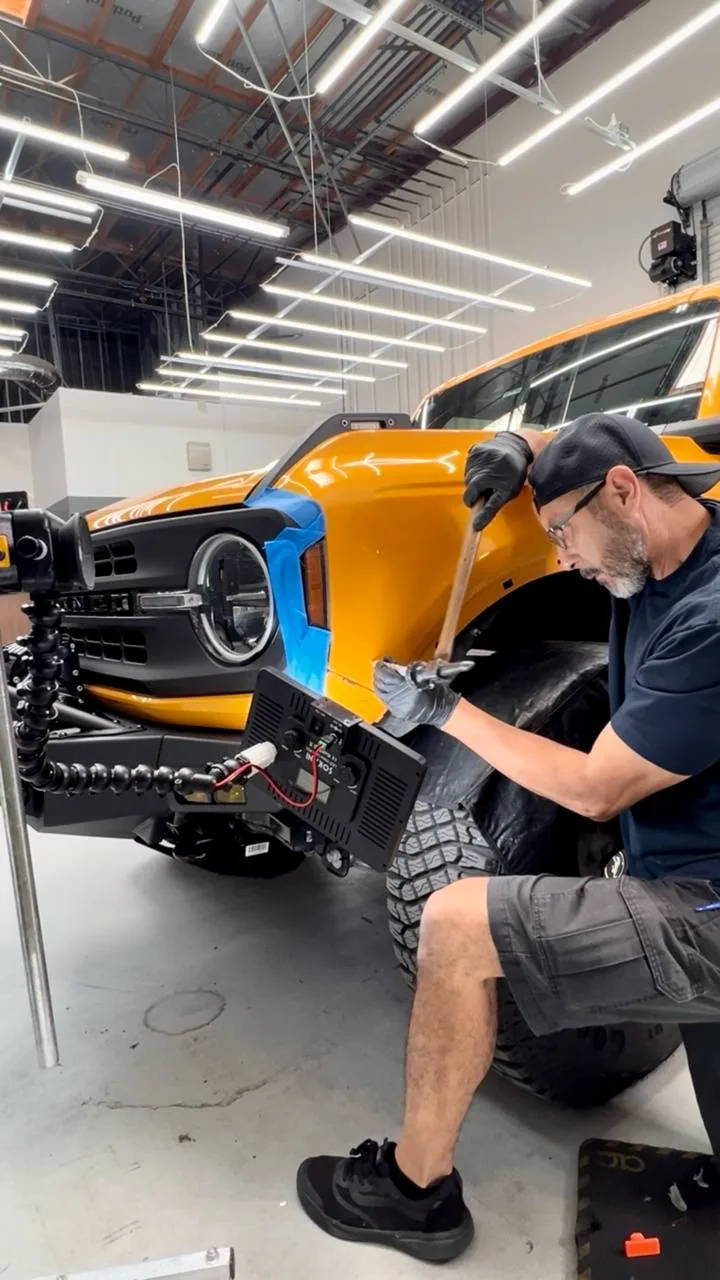
Every dent that comes through Dent Evo gets the same first look. Three checks before I commit to the repair:
- Paint condition. Is the paint intact? If a fingernail or a flashlight at low angle catches a crack or a chip, the dent isn’t a clean PDR candidate. I tell the customer up front.
- Dent geometry. Is the metal stretched? A dent with sharp edges or a rebound profile may not return to factory geometry. I read it under a checking light before I touch it.
- Panel access. Can I get to the back of the panel correctly? Some panels — extended quarter panels, F-150 bedsides, Wrangler door interiors — need trim or liner removal. If the access isn’t right, the repair won’t be right.
If any of those three checks fails, I tell the customer. Sometimes that means recommending body shop work instead. Sometimes it means a partial PDR repair followed by touch-up paint. What it never means is taking a job I can’t complete to factory standard. That’s the source of the “PDR ruined my paint” stories — shops that took work they shouldn’t have.
What to Ask a PDR Shop Before Booking
If you’re calling around to PDR shops, ask these five questions. The answers tell you whether the shop knows what they’re doing.
Five Questions That Reveal a PDR Shop’s Quality
- How long have you been doing PDR? Look for 5+ years minimum. The technique has a long learning curve.
- Do you have aluminum-specific tooling? Critical for any 2015+ F-150, Tesla, Rivian, Lucid, or Lexus panel. Steel-era tools leave marks on aluminum.
- Will you turn down work that isn’t a PDR candidate? A shop that always says yes is a shop that takes work it can’t complete. Honest shops turn down the wrong jobs.
- What’s your guarantee? Look for a complete satisfaction guarantee. The repair should come back to factory standard — or you don’t pay.
- Can you give me a specific price from a photo? Shops that need to “see it in person” before quoting are often padding for in-shop upsell. A skilled PDR tech can quote off a clear photo within minutes.
When Paint Repair IS Needed
PDR is the right answer for most dents. It’s not the right answer for all of them. Paint repair is needed when:
- The paint is cracked, chipped, or flaking at the dent
- The dent has a sharp crease over a body line that has stretched the metal beyond what PDR can return
- There’s primer or bare metal showing
- The damage includes scratches that go through the clear coat
An honest PDR shop will tell you when paint repair is the better option. That’s part of the value of working with a specialist instead of a shop that takes every job that walks in. Knowing what you can’t fix is part of doing the work right.
PDR doesn’t ruin paint when it’s done correctly. The painted surface isn’t touched — the repair happens entirely from behind the panel. The variable isn’t PDR itself; it’s the technician. A skilled PDR tech with the right tools and the willingness to turn down unsuitable jobs gives you a repair that’s invisible. A shop that takes every job and uses generic tools gives you a problem.
PDR & Paint FAQ
Will PDR weaken my paint over time?
Can PDR cause cracks in the clear coat?
What happens if the paint was already damaged before the repair?
Does PDR work on every paint color?
How do I know if my dent is a PDR candidate?
Send a photo. Get an honest read
on whether PDR is right.
If your dent isn’t a PDR candidate, Joe will tell you straight. No upsell, no “come in so we can see.” Just an honest answer.
Get a Free Photo Estimate Or call (909) 340-3440 — Joe picks up.