Mobile PDR vs Shop PDR — Why In-Shop Wins
Mobile PDR sounds convenient. But you can’t get a great repair in a parking lot. Here’s the honest comparison — and the few cases where mobile makes sense.
I’ll start with the conclusion: I’m in-shop only by choice. I made that decision after years of doing both — mobile work in the early part of my career, and dedicated shop work since I built out the Dent Evo location in Upland. The repairs I do in the shop are better than the repairs I did in driveways and parking lots. Not slightly better. Categorically better. And after almost three decades in PDR, I’m not willing to give up the difference.
This post explains what mobile PDR actually offers, what’s missing, where it makes sense, and why complex damage requires a shop. I’m not knocking mobile PDR techs — there are good ones. But the trade-offs are real, and most customers don’t realize they’re making them.
What Mobile PDR Actually Offers
Mobile PDR brings a technician to your driveway or office parking lot. The tech arrives with a portable rig — usually a van or SUV with a folding setup — sets up next to your car, and works the dent on the spot. The pitch is convenience. No drop-off, no rental, you keep working while the dent gets fixed.
For the right kind of dent, mobile PDR can produce a clean result. A small, shallow ding on a flat door panel, in a location with good natural light, on a vehicle parked on level ground — that’s the dent that mobile PDR was designed for. Done by a skilled tech with portable lighting, the result can be indistinguishable from shop work.
The problem is that most dents aren’t that dent. Real damage shows up in worse positions, on sharper panels, in worse lighting, with more variables — and that’s where the in-shop advantages start to matter.
What’s Missing in a Driveway
Lighting
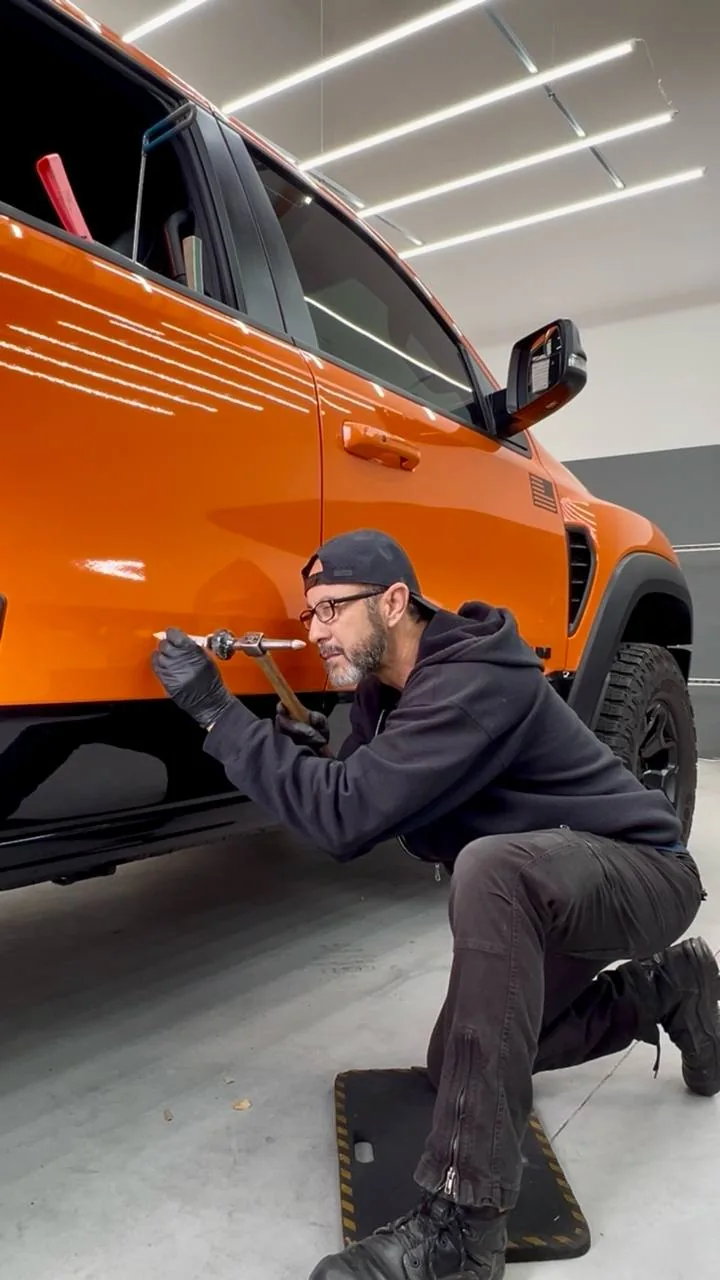
This is the biggest issue. Reading a panel during PDR requires consistent, controlled lighting. The technique depends on watching reflections move across the surface as the dent comes out — that’s how the tech knows when the panel is back to factory geometry and when to stop pushing. Outdoor light changes constantly. Cloud cover shifts, sun angle moves, reflections get washed out by stray surface glare. Portable mobile lighting helps, but it’s not the same as a dedicated PDR booth with overhead checking lights, side lighting, and a controlled background.
The result of bad lighting is high spots — places where the technician pushed too far because they couldn’t see the panel correctly. A high spot looks fine in a parking lot. It catches your eye the next time you wash the car in direct sunlight. The customer walks back outside, sees the imperfection, and now has to either live with it or call back the shop.
Controlled Environment
Wind, dust, rain, temperature swings — these all affect PDR work. Wind blows debris onto the panel and into the technician’s tools. Dust on the painted surface obscures reflections. Rain stops work. Temperature affects how the metal responds to pressure — aluminum especially behaves differently at 50°F than at 95°F.
A shop has none of that. The temperature is controlled, the air is clean, the work area is dedicated to one task. The repair gets the tech’s full attention without environmental distractions.
Full Toolset
Mobile PDR techs travel with what fits in their van. Even the most equipped mobile rig carries a smaller subset of what a dedicated shop has on hand. When a dent turns out to need a tool that’s not in the mobile kit, the tech either improvises with what they have (often poorly) or has to reschedule for the shop visit they were trying to avoid.
I have hundreds of rods, tips, glue tabs, and pulling tools at the shop. Some of them I use once a year — but the once-a-year repair is the reason I have them. The right tool for the dent is sometimes the difference between a clean repair and a botched one.
Safety for EVs and Aluminum-Body Vehicles
Tesla, Rivian, Lucid, F-150 (2015+), and Lexus aluminum-body panels need aluminum-specific tooling. Most mobile PDR rigs don’t carry that tooling — partly because of cost and partly because mobile work tends to focus on commodity dent repair on conventional steel panels. The aluminum-specific tips, rods, and glue systems are an investment that mobile shops often skip.
For EVs there’s another consideration: working safely around the high-voltage architecture. A shop has dedicated lifts, controlled approach to underbody panels, and the space to lay out the right tooling. A driveway doesn’t. PDR doesn’t touch the HV system on any EV — but the controlled environment matters for confident, careful work.
Edge Cases Where Mobile Makes Sense
I’m not going to pretend mobile PDR has no place. There are situations where mobile is the right answer:
- Small ding on a flat panel. A quarter-sized door ding on a sedan door, in good outdoor lighting, in a level parking spot. A skilled mobile tech can handle this cleanly.
- No time to get to a shop. Some customers genuinely can’t drop off a vehicle. For them, a mobile tech who can do the simpler dent in their parking lot is better than no repair at all.
- Fleet vehicles where downtime is the cost driver. Companies that can’t pull vehicles out of service for a half-day sometimes prefer a mobile tech who comes to the lot and handles multiple cars in sequence.
Outside those situations, the trade-off doesn’t favor mobile. You’re trading repair quality for convenience — and on a vehicle you paid real money for, that trade isn’t usually worth it.
Where Complex Damage Requires a Shop
The line between “mobile-eligible” and “shop-only” damage is a real line. Dents that fall on the shop side include:
- Body line dents. A dent that crosses or sits next to a styling line (CR-V quarter, Lexus shoulder line, Wrangler fender flare line) needs reading time, careful technique, and consistent lighting.
- Aluminum panels. F-150 (2015+), Tesla, Rivian, Lucid, Lexus aluminum doors. Aluminum requires specific tooling and time most mobile rigs don’t carry.
- Multi-dent damage. Hail damage, parking lot pile-ups with multiple separate dents, tailgate damage with a primary dent and secondary tension marks. These need shop time.
- Quarter-panel and bedside repairs. Limited inner access usually requires removing trim, dropping liners, or repositioning a panel. Mobile work doesn’t have the time or space for that prep.
- Anything where lighting matters. Premium paint (Lexus, Mercedes, Audi, Tesla) shows imperfections more readily. The repair has to be checked under shop lighting before the customer leaves.
The Trade-Off You Make
Mobile PDR’s pitch is convenience: no drop-off, no rental car, the tech comes to you. The trade-off is repair quality on anything more complex than a small flat-panel ding. For some dents, that trade is fine. For most, it isn’t.
In-Shop PDR Wins
- Controlled lighting for accurate panel reading
- Stable temperature for predictable metal behavior
- Full toolset including aluminum-specific gear
- Space to remove trim, drop liners, take doors off hinges
- Final check under shop lighting before delivery
- Better repair on anything complex
Mobile PDR Edge Cases
- Small flat-panel ding in good outdoor light
- Customer can’t drop off (logistics)
- Fleet work where downtime cost is high
- Conventional steel panel, no body line crossing
- Single dent, accessible from outside the panel
- OK for the right dent, wrong for most
I don’t do mobile work. After 28 years, I’d rather turn down a job I can’t do correctly than hand the customer a “convenient” repair that doesn’t hold up in sunlight. The shop in Upland has the lighting, the tools, and the time. That’s why the work that comes out of it is consistent. Convenience matters — but on the panels of a car you care about, repair quality matters more.
Not sure if your dent is mobile-friendly or shop-only? Joe will tell you straight.
Mobile vs Shop PDR FAQ
Does mobile PDR cost less than shop PDR?
Why does lighting matter so much for PDR?
Can mobile PDR handle aluminum-body vehicles like the F-150 or Tesla?
Can complex damage like hail be repaired in a driveway?
How do I decide between mobile and shop PDR?
Get an honest read on whether
your dent needs the shop bench.
Joe will tell you straight whether your repair is mobile-friendly or shop-only — and either way, what it costs.
Get a Free Photo Estimate Or call (909) 340-3440 — Joe picks up.