Panel Science — PDR Guide
Aluminum vs. Steel Panels — Why It Matters for Dent Repair
The material your car’s panels are made from isn’t just an engineering detail — it directly affects how a dent happens, how it’s repaired, how long that repair takes, and what it costs. If your vehicle has aluminum panels, there are things you need to understand before getting a quote.
How Steel and Aluminum Behave Differently When Dented
Steel is relatively ductile. When a steel panel takes an impact, the metal tends to deform gradually — it stretches and pushes inward. That stretch is predictable and, within limits, reversible. A PDR technician can apply controlled pressure from behind and coax the metal back toward its original shape. Steel has memory, but it’s forgiving.
Aluminum behaves differently. It’s lighter and can be made into thinner sections, but it’s less ductile than steel. Under impact, aluminum is more likely to crack internally at a microscopic level before visible deformation becomes severe. It deforms more abruptly and, critically, it work-hardens when stressed.
What “Work Hardening” Means
When aluminum is deformed, the internal crystalline structure of the metal reorganizes. The material around the impact point becomes harder and more brittle than the surrounding undamaged metal. This is called work hardening. The practical consequence: you cannot apply the same pressure to aluminum that you’d apply to a steel panel of comparable thickness. Too much force, and the metal cracks rather than moves.
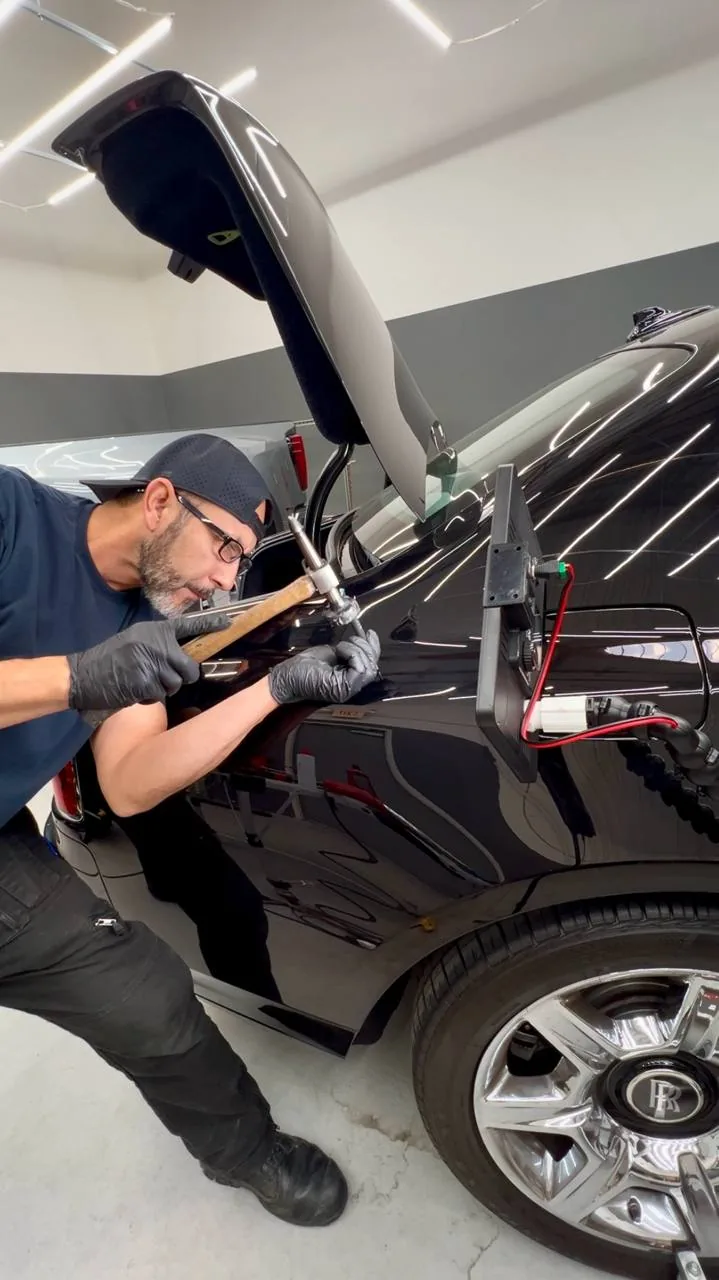
PDR on aluminum requires lighter, more deliberate pressure with specialized tools — usually smaller-tipped, and applied over more passes. The work takes longer. The margin for error is narrower.
Vehicles Commonly Using Aluminum Body Panels
Aluminum usage has increased significantly as manufacturers chase fuel efficiency and EV range through weight reduction. Common examples:
- Ford F-150 (2015–present) — Full aluminum body. Every exterior panel except the steel frame is aluminum. This was a significant industry shift when it launched.
- Tesla Model S — Full aluminum body structure and panels.
- Tesla Model 3 and Model Y — Mixed aluminum and steel; hoods and some doors are aluminum.
- Rivian R1T and R1S — Aluminum-intensive construction throughout the body.
- Audi A8 — Aluminum Space Frame (ASF) construction; all exterior panels are aluminum.
- Range Rover (most recent generations) — Predominantly aluminum structure and panels.
- Jaguar XE, XF, F-Pace — Aluminum-intensive platforms.
- BMW 7 Series and select 5 Series — Carbon fiber and aluminum mixed construction on newer generations.
- Lucid Air — Full aluminum body, ultra-thin panels engineered for maximum weight savings.
- Mercedes-Benz EQS — Mixed aluminum and steel; aluminum in many exterior panels.
If you’re not sure what your panels are made of, the owner’s manual sometimes specifies. A magnet test works in a pinch — magnets don’t stick to aluminum.
Cost Implications
Aluminum dent repair generally costs more than equivalent steel repair for two reasons: time and skill. The controlled, multi-pass approach needed on aluminum takes longer. The tools are different and more specialized. And the risk of a result that requires a second pass — or conventional bodywork — is higher if the damage is at the edge of what PDR can address.
At a body shop, aluminum repair costs even more. Aluminum panels are expensive to replace, and collision shops require technicians specifically certified for aluminum repair. They must use dedicated aluminum tools to avoid cross-contamination with steel particles (steel particles embedded in aluminum cause galvanic corrosion). All of that adds up fast.
This is part of why PDR — even at a higher cost than steel PDR — is still worth pursuing on aluminum vehicles. A hood replacement on an F-150 or a door replacement on a Tesla runs into the thousands before paint and labor. PDR avoids that entirely when the damage qualifies.
Paint Is at Higher Risk on Aluminum After Impact
Because aluminum deforms more abruptly than steel, the paint layer over an aluminum panel is under more stress at the moment of impact. The flexing happens faster and the paint has less time to move with the metal. This means paint cracking or micro-fracturing is more common on aluminum dents than steel dents of comparable severity.
This doesn’t mean aluminum dents always have paint damage — many don’t. But it’s a factor to check carefully. If paint is cracked even slightly on an aluminum panel, a body shop repair to that section will be needed in addition to the dent correction.
When Aluminum Damage Crosses Into Body Shop Territory
PDR on aluminum works well for dents that are:
- Smooth depressions without sharp creases
- Away from body lines and edges
- Not accompanied by paint cracks
- Not in areas with rear access limitations
PDR becomes difficult or impossible when aluminum damage involves a hard crease, when the metal has work-hardened to a degree that it no longer moves consistently, or when there is any surface cracking — either in the paint or the metal itself. At that point, the panel typically needs conventional repair or replacement.
A credible PDR technician will tell you this before starting work, not after. If someone gives you a quote on aluminum damage without asking specific questions or inspecting it carefully, that’s a warning sign.
Frequently Asked Questions
How do I know if my car has aluminum panels?
Check with a magnet — it won’t stick to aluminum. Your owner’s manual may also list panel materials. If your vehicle is a recent F-150, Tesla, Audi A8, Range Rover, Lucid, or Rivian, assume aluminum unless told otherwise.
Is PDR on aluminum always more expensive?
Generally yes. The skill and time required are greater. Exact cost depends on dent size, location, and accessibility — but expect aluminum repair to run higher than the same dent on a steel panel.
Can any PDR technician work on aluminum?
Not all have experience with it. Ask directly. Working aluminum requires different tools, different technique, and the judgment to know when to stop. Inexperienced technicians can cause additional damage by applying too much pressure.
My F-150 door has a dent — should I go to the dealer or a PDR shop?
Get a PDR estimate first. Dealers typically subcontract PDR work anyway, and the markup goes to the dealer. An experienced PDR technician who works on aluminum regularly will give you an honest read on whether the dent qualifies.
Aluminum dent on your F-150, Tesla, Rivian, or Lucid? Send a photo — Joe will tell you what’s actually possible.
PDR vs. Body Shop
Real Numbers: PDR vs. Body Shop Pricing
Same result. No paint. No Carfax record. See how we compare.
| Repair Type | Dent Evo PDR | Body Shop | You Save | Carfax Clean | Factory Paint | Same Day |
|---|---|---|---|---|---|---|
| Single Door Ding | $195 – $295 | $400 – $700 | ~$350+ | Yes | Yes | Yes |
| Minor Dent (1 panel) | $250 – $350 | $500 – $900 | ~$450+ | Yes | Yes | Yes |
| Body Line Crease | $400 – $700 | $800 – $1,500 | ~$700+ | Yes | Yes | Yes |
| Large Impact (1–2 panels) | $500 – $1,500 | $1,200 – $3,000 | ~$1,000+ | Yes | Yes | Yes |
| Moderate Hail Damage | $800 – $2,000 | $2,500 – $5,000 | ~$2,000+ | Yes | Yes | 2–3 days |
| Severe Hail / Multi-Panel | $2,000 – $4,000 | $5,000 – $12,000 | ~$5,000+ | Yes | Yes | Days |
Body shop estimates are market averages. PDR pricing varies by dent size and access. View full pricing guide → · Try the instant estimate tool →
In the Shop
Real Vehicles. Real Repairs. Upland, CA.